When neighbours in NSW can't agree on a dividing fence, settle the line first with a boundary notice if it is in doubt, use mediation if it helps, then ask NCAT or the Local Court for a fencing order, remembering that neither an order nor an agreement binds whoever buys next door.
A dividing fence dispute in NSW runs on at least ten separate clocks. We counted them across Legal Aid NSW's fence pages: 7 days to answer a boundary notice, 1 month before a surveyor can be hired, at least 21 days to answer a boundary determination and 28 days to appeal it. Then come 1 month of completion to challenge an urgent-work bill and 3 months for agreed work when no time was set. The long ones are 6 years to claim half of urgent work, 6 years to claim on a broken agreement, 6 years to register an NCAT order and 12 years from registration to enforce it.
The pattern is the useful part. The short clocks belong to whoever wants a say in the fence. The long ones belong to whoever is owed money. If a neighbour writes to you about the boundary, or about work they have already done, read the dates before anything else.
If you haven't served a Fencing Notice yet, start with our guide to who pays for a dividing fence in NSW. What follows is for when your neighbour still disagrees: about the line, the fence or the bill.
Surveyor costs usually shared equally. If the survey confirms the neighbour's pegs, the neighbour can claim their costs from you.
If you disagree about where the line runs, either of you can serve a written boundary notice saying you intend to hire a registered surveyor. There is no set form.
Your neighbour then has 7 days to peg out where they think the line is, or hire their own registered surveyor. Either way, they must tell you in writing.
If they do neither, or only peg, and one month passes, you can hire a registered surveyor. Costs are usually shared equally.
Here is the catch. If the surveyor confirms the neighbour's pegs were right, the neighbour can claim their costs from you. Look hard at their pegs before you book anyone.
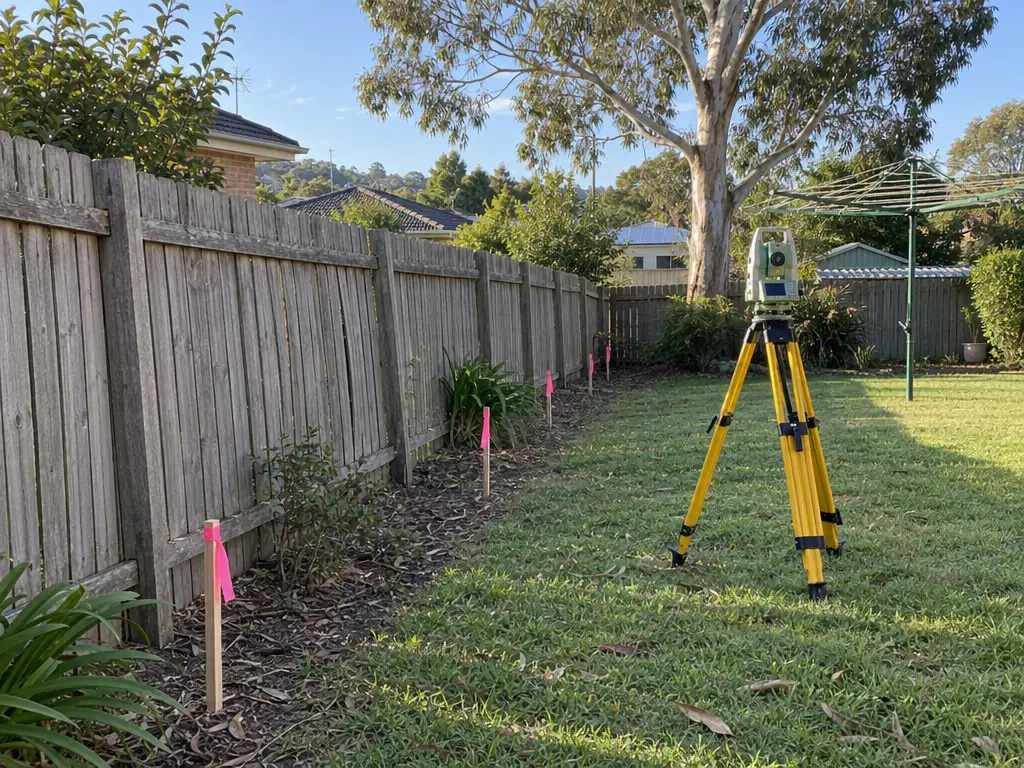
With two conflicting surveys, either owner can apply to the Registrar General for a Determination of Title Boundary, but only where some doubt has been raised. The other owner usually gets at least 21 days to respond, and an appeal to the Land and Environment Court is within 28 days.
If the line only matters for the fence, Legal Aid NSW says a boundary notice is usually cheaper and faster.
Most fence disagreements climb the same rungs. You can skip some. The Fencing Notice is the one NCAT asks to see: its application needs the Fencing Notice attached.
Talk first. Most fences get built this way, and a conversation costs nothing.
Put it in writing. If you agree, write it down. The section on agreements below lists what to include.
Mediation, if it helps. Mediation is not compulsory, and you can try it before or after a Fencing Notice. A mediator does not decide who is right. An agreement reached there is generally enforceable only if both agree it is binding.
Free Community Justice Centre mediation is for disputes referred by NSW courts or under the Associations Incorporation Act 2009, so don't plan on it as a free first step for a fence.
To find a mediator, Legal Aid NSW points to the Local Court's mediation page. That page says mediators don't take sides or decide. For neighbour disputes, it says mediation generally works better informally, without lawyers taking an active role. It may not suit you if you don't feel safe or there is a power imbalance.
Fencing Notice. Our earlier guide covers what goes in it. One wrinkle if next door is rented: the State Library's older guide says a Fencing Notice usually goes to the owner, and goes to a tenant only where five years or more remain on the tenancy.
NCAT or the Local Court. This is where someone other than the two of you decides.
| Question | NCAT | Local Court |
|---|---|---|
| Orders it can make | Same orders | Same orders |
| Time to list | Aims to list within four weeks of application | Wait varies, rural courts may sit less often |
| Before the hearing | Conciliation | No mediation of its own, a magistrate may refer parties to mediation |
| Transfers | Can transfer a case to the Local Court | Can transfer a case to NCAT |
| Enforcing a money order | Can't enforce its own orders, certificate then register with the Local Court | Enforced directly |
| Neighbours in different states: NCAT may not be able to decide the matter. | ||
| At NCAT most people represent themselves; concession card holders get a reduced fee. | ||
Both can make the same orders. The path differs.
NCAT aims to list within four weeks and conciliates before the hearing. The Local Court's wait varies, and rural courts may sit less often. It has no mediation of its own, though a magistrate may refer you. Either can transfer a case to the other. If you and your neighbour live in different states, NCAT may not be able to decide the matter.
NCAT's Consumer and Commercial Division can order what the fence is made of, its height, where and when it is built, and how costs are split. Its s14(1) orders also cover the boundary line the work follows, which portion each owner builds or repairs, compensation for loss of use of land, and an order that no dividing fence is needed.
The application must quote the section and attach details of the fencing work and a quote. It also needs the Fencing Notice, evidence (photos, receipts, survey if available) and the other party's correct legal name.
Matters are first listed for conciliation and hearing. Most people represent themselves, and concession card holders get a reduced fee.
This is general information, not legal advice. For your own situation, ask Legal Aid NSW, LawAccess NSW or NCAT directly.
The tribunal can also award costs of the case against either party. Source: State Library of NSW, Neighbours and the law (older guide; check current position with NCAT or Legal Aid NSW).
When neighbours can't agree on the fence itself, the tribunal decides what is sufficient. The State Library's guide lists what it weighs: the existing fence, land uses, privacy and other concerns, the usual fence in the locality, and any council policy or planning instrument. It can also award costs of the case against either party.
That guide is an older one, so treat its two examples as background and check the current position with NCAT or Legal Aid NSW.
When the cost split isn't equal
| Situation | What Legal Aid NSW says |
|---|---|
| One owner wants a higher standard | That owner pays the difference |
| One side damaged the fence | Costs may not have to be shared equally |
| Neighbour is a public authority | Does not have to contribute; you can try to negotiate |
| The fence is also a pool fence | The pool owner usually pays that section |
Half each is the usual starting point, not a rule for every case. Costs may not have to be shared equally where one owner wants a higher standard (they pay the difference), where one side damaged the fence, where the neighbour is a public authority, or where the fence is also a pool fence. In that last case the pool owner usually pays that section. Our spring pool fence check covers the barrier rules for a boundary fence that does double duty.
Our view at Aardvark Chainwire Fencing: no fence type wins by default. See-through chain mesh suits a boundary where light, airflow or a clear line of sight matter. A solid sheet or timber fence answers privacy. Because privacy is one of the things a tribunal weighs, the honest starting point is what each household needs from that line. Our comparison of chainwire, Colorbond, timber and welded mesh sets out the trade-offs.
Costs may not have to be shared equally where work was done without agreement or a Fencing Order, unless the work was urgent.
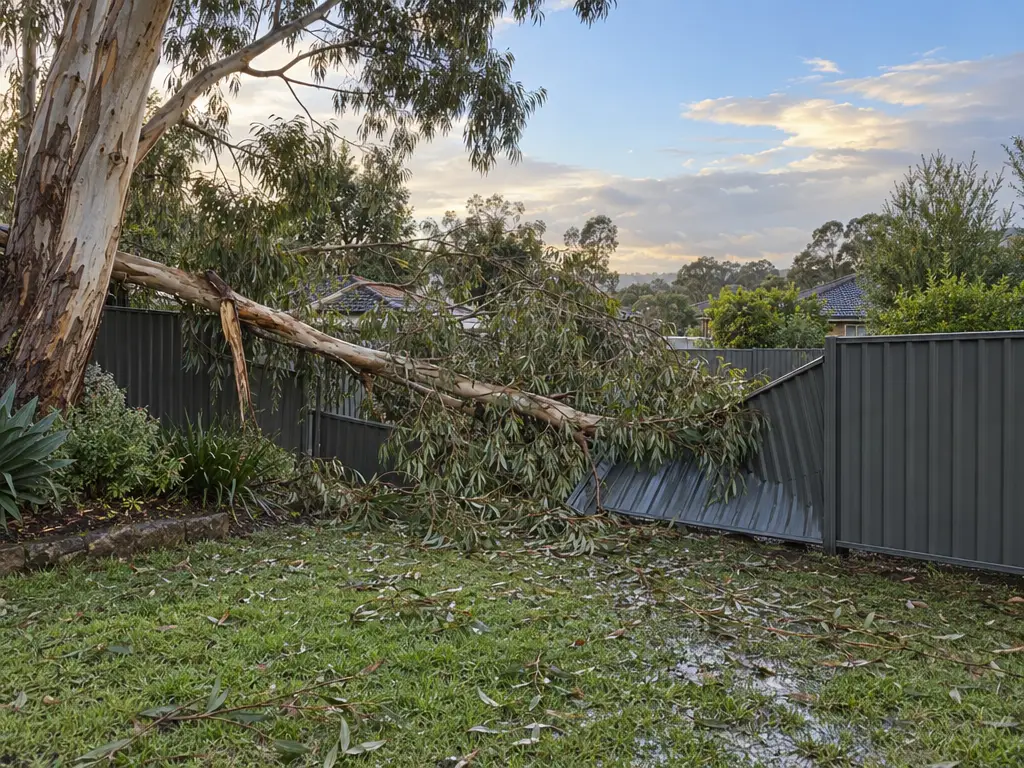
Urgent work means an existing fence was damaged or destroyed and serving a notice was impractical, for example because you need to act very quickly to secure your land. A claim for half must be made within 6 years of completion. The other neighbour must challenge it within 1 month of completion, though late applications may be allowed. Legal Aid NSW advises getting legal advice first.
This matters now. NSW SES storm season runs September to April, and the SES says roughly 7,000 incidents involving fallen trees in its last storm season.
The Act covers a retaining wall only where the wall is necessary to support and maintain the dividing fence. NCAT won't hear one without evidence of that, and most such disputes go to the NSW Supreme Court. Legal Aid NSW suggests a structural engineer's report and legal advice.
On approval, a wall needs none if it is under 60 cm, at least 1 m from any boundary, easement, sewer or water main, and meets the other listed conditions on heritage, flood, water bodies and 2 m separation from other walls. Read that 1 m condition twice: a retaining wall on the boundary itself sits outside the exemption.
You can't enter your neighbour's land without permission, except under an agreement, a court or NCAT order, an Access to Neighbouring Land Act order, or for urgent work. Otherwise it is trespass. Before anyone digs post holes, lodge a free Before You Dig Australia enquiry.
Breach claim in the Local Court within 6 years. No split stated: usually half. Agreement that breaks council rules may not be enforceable.
A written agreement should cover fence position, height, length, material, colour, timing, who does the work and who pays.
If a neighbour breaks it, the claim in the Local Court is within 6 years. If no split was stated, a claim is usually for half. If the work follows a Fencing Notice and isn't done in the agreed time, or 3 months if none was set, you may do it and claim. An agreement that breaks council rules may not be enforceable.
The State Library's guide says a neighbour agreement or Dividing Fences Act order will not be binding on subsequent owners if a property is sold.
It is an older guide, so confirm the point with Legal Aid NSW if a sale is coming. If either of you is selling, getting the fence built before settlement is the safer plan.
NCAT can't enforce its own orders. You get a free NCAT certificate of the amount, then register it with the Local Court. You have 6 years to register and 12 years from registration to enforce. Local Court orders are enforced directly.
Our estimate, adding those two periods: a registered NCAT money order can stay enforceable for up to 18 years after the decision, if it is registered late in the six-year window.
The chart sets the ten periods side by side, with NCAT's four-week listing aim marked separately. Everything up to three months is about having your say. Everything from six years up is about getting paid.
Even a fence both neighbours want has limits. Check the title for covenants, easements and restrictions on user. Check council rules too: bush fire prone areas may restrict flammable materials. Under exempt development, fences on bushfire prone land must be non-combustible or hardwood.
Once you know what the line allows, the fence is the easy part. Aardvark Chainwire Fencing does chainwire, security and boundary fencing across Newcastle and the Hunter, including chainwire and black chain wire fences. Tell us where the boundary runs, roughly how long it is and what you and your neighbour have agreed, through our contact page.
Pictures in this guide are illustrations, not photos of our jobs.